
by Giuseppe Roberto
According to the information passed down to us through several bibliographical sources, it would seem not. In “U ciaramiddharu a Messina” (1959), Antonino La Camera writes: “My father, who died at the age of ninety-one in October 1957, remembered Mastru Paulu u Turnaru, a city ciaramiddaru who played every year at the Sanctuary of Montalto. However, he was not very successful in Messina because the people of Messina preferred the ciaramiddari i paisi, who more strongly evoked the image of shepherds in their memories. (…) The contradanza, together with other compositions (a calabrisedda, a nciga, u scurdinu), was played in churches by city zampognari, accompanied by the organ.” Why does the text refer to city zampognari?
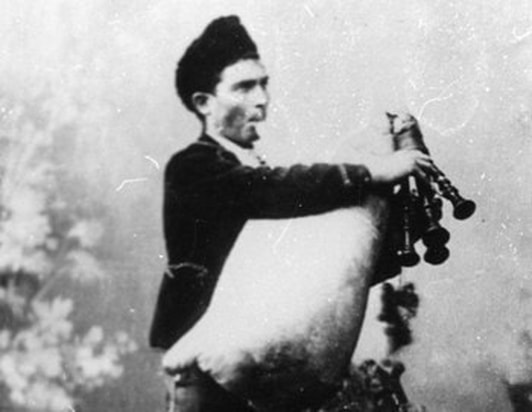
To understand what we are talking about, we need to take a step back in time and examine the writings of Leopoldo Nicotra (1846–1940), a botanist from Messina, musician and enthusiast of local history. These writings had already been mentioned in publications by ethnomusicologists Sergio Bonanzinga (1993) and Mario Sarica (1994). “Church zampognari are almost all craftsmen, among whom the most famous and skilful in my time was a cooper; they performed various pieces, which I remember very well and transcribed into a special collection, never using their instrument for revelry, as peasants were accustomed to doing. The piece known as Scordino was truly captivating (…)”.
At a certain point in our journey through history, particularly towards the end of the nineteenth century, this distinctive group of musicians disappeared, leaving zampognari from the Sicilian countryside—namely farmers and shepherds—as the only remaining performers.
They attempted, to some extent, to reproduce the repertoire of the city’s professional musicians in an approximate and evocative manner, despite lacking the same musical skills. The Sicilian historian Giuseppe La Corte Cailler discussed this phenomenon in 1906: “He took care to transcribe the music of the Litany and that of the Pastorale, traditionally performed during the Christmas novena in Messina (…) They now display considerable modifications and alterations, to the extent that even the key has changed, from minor to major, and one of the most popular Neapolitan songs has been added as a finale. Passed down by tradition to uneducated farmers who played the bagpipe only occasionally, it has lost its original beauty(…).” From these words, we can conclude that in the distant past, culminating at the dawn of the twentieth century, the zampogna was not played exclusively by shepherds and residents of the small villages and rural settlements of the Sicilian countryside. An urban tradition also existed, consisting of zampognari from artisan backgrounds who played alongside the organ in churches during novena services. They had their own established repertoire and used the instrument in a more musically complex way than rural players.
Based on the sources currently known, this tradition is documented in the cities of Messina and Palermo. However, this distinctive ancient practice may also have existed in other cities, as well as in smaller towns across the island and in other areas of southern Italy. Today, we can reflect on whether we should continue to restrict the instrument’s true potential by reproducing unchanged the declining tradition handed down to us from the second half of the last century, or breathe new life into the Sicilian zampogna and resume a journey that builds a bridge between an interrupted past and the future. The choice is ours.
No Comments